Perhaps the most iconic American female archetype to permeate the global pop-culture landscape is that of the “girl next door” persona. And, there is perhaps no more iconic a representation of this archetype than the late, great Farrah Fawcett.
In the ‘70s and ‘80s, Farrah Fawcett established herself as one of the most prominent celebrities and foremost “it-girls” of the time. From projects such as Charlie’s Angels and The Burning Bed, she dominated the silver screen and inspired global beauty trends for close to two decades.
However, her rise to pop-culture royalty didn’t happen by coincidence. Rather, it was only after a certain poster of Fawcett in a simple red swimsuit was published in 1976 that she shot to stardom, and the global fashion landscape was changed forever.
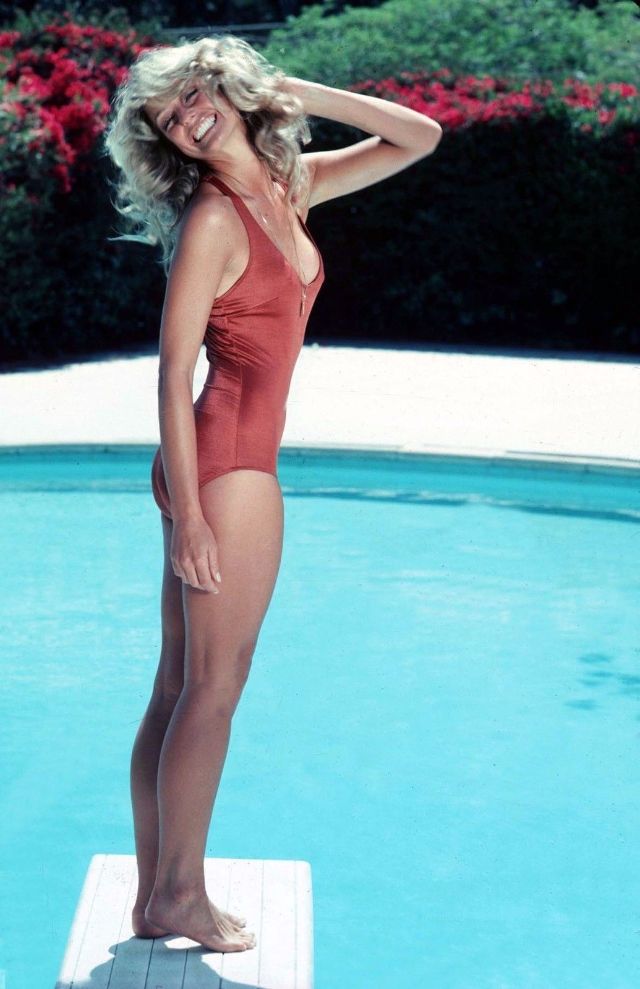
The poster in question was commissioned by Pro Arts, a pin-up poster company, and shot by photographer Bruce McBroom at Fawcett’s Los Angeles home in the summer of 1976. There was no set design, save for a striped blanket in the background, and, crucially, no styling, giving Fawcett free rein over her wardrobe. For this, she selected a simple red Norma Kamali one-piece with a plunging scoop-neck and brief-style cut.
When the poster was published later that year, it caused nothing short of an uproar. Within its first year of print, it sold over five million copies and has since sold twelve million in total, making it the best-selling poster of all time.
It propelled Fawcett and her red one-piece into the limelight, earning them both a place in pop-culture history. In 2011, the Smithsonian Institute even went so far as to display the Norma Kamali swimsuit at the National Museum of American History, solidifying its status as a culturally significant object.
Aside from smashing records, Fawcett’s poster also ushered in a new beauty standard. In his 2003 essay “The Politics of Farrah’s Body: The Female Icon As Cultural Embodiment”, professor of Women’s and Gender Studies at the University of North Carolina Wilmington Chadwick Roberts explains that Fawcett’s appearance contrasted both with the voluptuous pin-ups of the ‘50s, such as Marilyn Monroe, and the androgynous starlets of the ‘60s, like Twiggy.
He says, “Fawcett’s hips are narrow, and her breasts are just ample enough … and her nose is long, thin, and prominent. The image … offers a new informed version of the all-American girl.” Simply put, she personified and popularized the now-commonplace “girl next door” aesthetic.

The poster also spawned an enduring love for the red one-piece. In 1990, Pamela Anderson made waves with her own rendition of the swimsuit, featuring a similar plunging neckline, on the television series Baywatch. And, in today’s social media era, one does not have to search very long to find celebrities like Selena Gomez, Olivia Rodrigo, Elizabeth Hurley, and Kai Gerber, to name a few, posting snaps from their beach vacations, donning crimson one-pieces.
The one person who wasn’t too pleased with the poster was the swimsuit’s designer, Norma Kamali. During a 2019 talk with the Victoria & Albert Museum in London (mentioned in WWD), Kamali revealed that Fawcett’s one-piece was actually a prototype. She elaborated, “It’s not properly tailored, as you can see in the image.”
On a recent episode of David Yontef’s Behind the Velvet Rope podcast, she doubled down, saying, “When I saw the poster, I was horrified because … I tested that style … and I thought, I’m not going to make that one again … it’s not good.”
Despite her dislike for the swimsuit, Kamali later softened her stance on the image. She joked, “I literally went along for the ride … That swimsuit had nothing to do with the success of that poster, I’ll tell you that.”